Creating a convincing Moon landing scene with AI takes more than just typing "astronaut on the Moon." The camera angle, movement, lighting, environment, astronaut actions, and even the imperfections in the footage all play a big part in making the final result feel believable.
Below, you'll find all the prompts I used to create the different shots, from the Moon surface and astronauts to the spacecraft and cinematic camera movements.
Feel free to copy them, adjust them, and use them as a starting point for your own AI video.
Before generating any footage, I made one reference image for everything that had to look the same from shot to shot: the astronaut, the Moon surface, the lunar module, the launch station, and the rover. Most of them are multi-view sheets on a single canvas, so the video model can see the subject from every angle.
All five were generated with GPT Image 2.5 Sunburst at 16:9.
A gold visor has to reflect something, so the prompt spells out that the reflection shows the lunar surface.
Studio reference sheet: complete late-1960s lunar pressure suit, 1960s historical engineering aesthetic, photographed against neutral light-gray background. Four distinct views on one canvas — full-body front, full-body right side, full-body back, and medium close-up of torso/chest with helmet and upper body.
Suit construction: predominantly off-white with warm ivory tones, not pure bright white. Heavy, bulky silhouette with thick layered padding visible throughout. Fabric appears wrinkled and textured from multiple layers. Accordion-ribbed flexible joints visible at elbows and knees — deep vertical corrugations. Reinforced seams running along arms and legs. Visible sewn construction throughout.
Torso: rectangular control unit and life-support attachment panel mounted across the front center of the chest — mechanical-looking hardware, switches, connectors, readout surfaces. Multiple hoses and connectors emerge from sides and lower torso. Metal fasteners, buckles, and attachment hardware distributed across the chest and waist. All hardware shows functional 1960s engineering — rivets, metal brackets, connector fittings.
Backpack: large rectangular life-support unit firmly mounted on the back, making the rear profile deep and boxy. Visible tanks, hoses, mechanical fittings, and control surfaces on the rear. Backpack sits high and extends well below the waist.
Helmet: large, rounded, oversized in proportion to the body. Highly reflective gold-tinted outer sun visor covering most of the face. The visor reflects the lunar surface — cratered terrain, surface texture, subtle shadows of the moon's geography visible in the reflection. Multiple layers of white protective material visible around the helmet crown and sides. Mechanical attachment points around the helmet's equator connecting to the suit collar. Subtle curved geometry, no modern streamlining.
Gloves: oversized, thick, heavily articulated. Multiple visible joints and articulation points. Thick protective padding at knuckles and palms. Rubberized appearance with fabric layers visible.
Boots: heavy, wide, layered construction. Designed for uneven terrain. Multiple material layers visible. Thick soles. Wide base for stability.
Materials: layered woven fabric, mesh panels in some areas, rubberized joints, visible metal hardware, hoses in white or gray, connectors and fittings throughout. No smooth modern materials. Appearance of assembled practical engineering rather than polished design.
Lighting: neutral, even studio illumination with soft fill. No harsh shadows. Even lighting across all suit surfaces to show construction and texture detail. Gentle top-side key light with neutral ambient fill. Realistic fabric highlights without gloss or shine.
Style: studio reference photography, sharp focus, fine detail visible on seams and hardware, natural film grain, neutral color cast, realistic surfaces and materials, 1960s documentation aesthetic. No dramatic lighting, no environment, no landscape. Neutral gray background. No text, labels, or annotations. Four views share identical lighting, scale, and neutral background. Full-body views share consistent ground line and scale. Close-up shows face area and upper torso with same lighting and material detail.
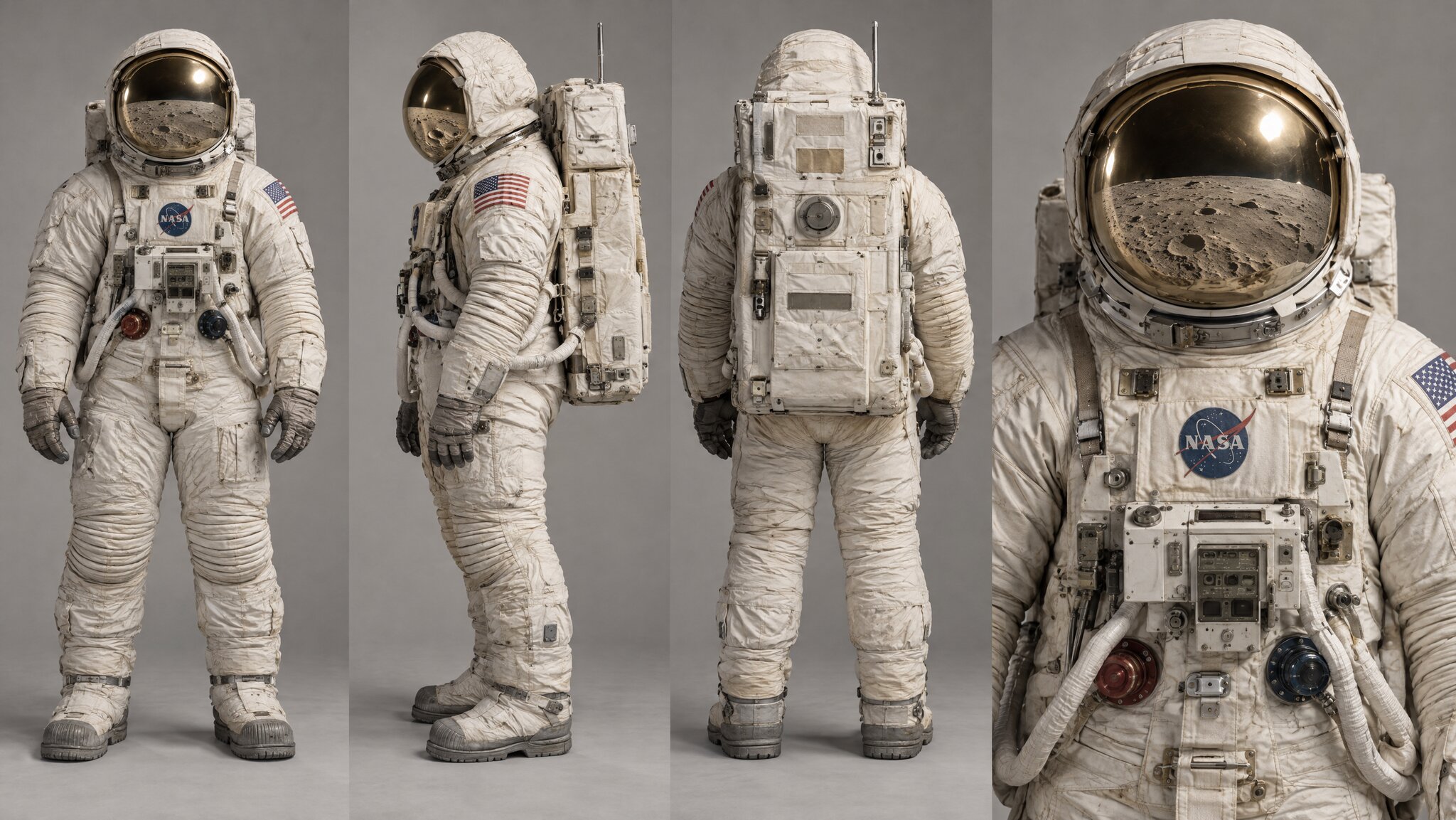
Four-view reference sheet of a bulky off-white late-1960s lunar pressure suit with a gold visor reflecting the lunar surface, shown from the front, side, and back plus a chest close-up
Late-1960s lunar surface environment reference sheet: four distinct landscape views on one canvas — wide expansive plain, medium mid-distance terrain, closer ground detail, and extreme close-up of regolith surface.
Terrain: vast grey regolith-covered landscape. Predominantly neutral grey tones ranging from pale ash-grey in sunlight to deep charcoal in shadow. Fine powdery texture visible across the surface. Gently undulating terrain with shallow craters, scattered small rocks embedded in surface, occasional larger boulders, subtle ridges, and natural depressions. Ground is uneven but not mountainous. Large empty areas of negative space. Terrain feels naturally irregular and believable, not procedurally generated. No sand dunes, no warm desert tones, no blue, brown, orange, or red hues.
Surface texture: powdery, dusty regolith with visible granular detail. Some areas appear soft and fine-grained, others more compact and slightly rough. Fine embedded stones visible at close scale. Natural footprint-like compression marks and subtle track patterns visible in close-up views. Dust remains on surface in clean ballistic form, no floating or billowing clouds.
Lighting: single extremely harsh distant light source creating severe directional illumination. Bright sunlit surfaces intensely illuminated. Deep dark shadows with almost no soft fill, razor-sharp shadow edges. Small rocks and surface irregularities cast long crisp shadows. Extreme high-contrast lighting between light and shadow areas. Unnatural compared to Earth photography.
Sky: completely black with no atmospheric haze, no blue gradient, no clouds, no mist, no scattering. Sharp clean transition between illuminated horizon and black sky. Stars generally suppressed by bright ground exposure, not visible in normal surface shots.
Horizon: relatively close and gently curved. Low rolling terrain visible in mid-distance views. Broad barren plain with shallow craters and scattered rocks. Expansive and isolated feeling.
Avoid: Earth desert landscapes, sand dunes, warm beige sand, dramatic mountain ranges, colorful rocks, atmospheric haze, visible wind, drifting dust clouds, blue sky, excessive craters, fantasy terrain, alien vegetation, glowing minerals, sci-fi lighting, neon colors, glossy surfaces, cinematic fog, volumetric light, artificial studio lighting, overly dramatic composition.
Style: authentic grey lunar regolith, scattered rocks, shallow craters, gently uneven terrain, completely black sky, harsh direct sunlight, razor-sharp shadows, airless environment, no atmosphere, no haze, no color cast, no cinematic sci-fi styling. 1960s space-era visual documentation aesthetic. Sharp focus on surface detail in close views, expansive clarity in wide views. Natural grain and realistic surface materials. Late-1960s lunar landing site photography reference.
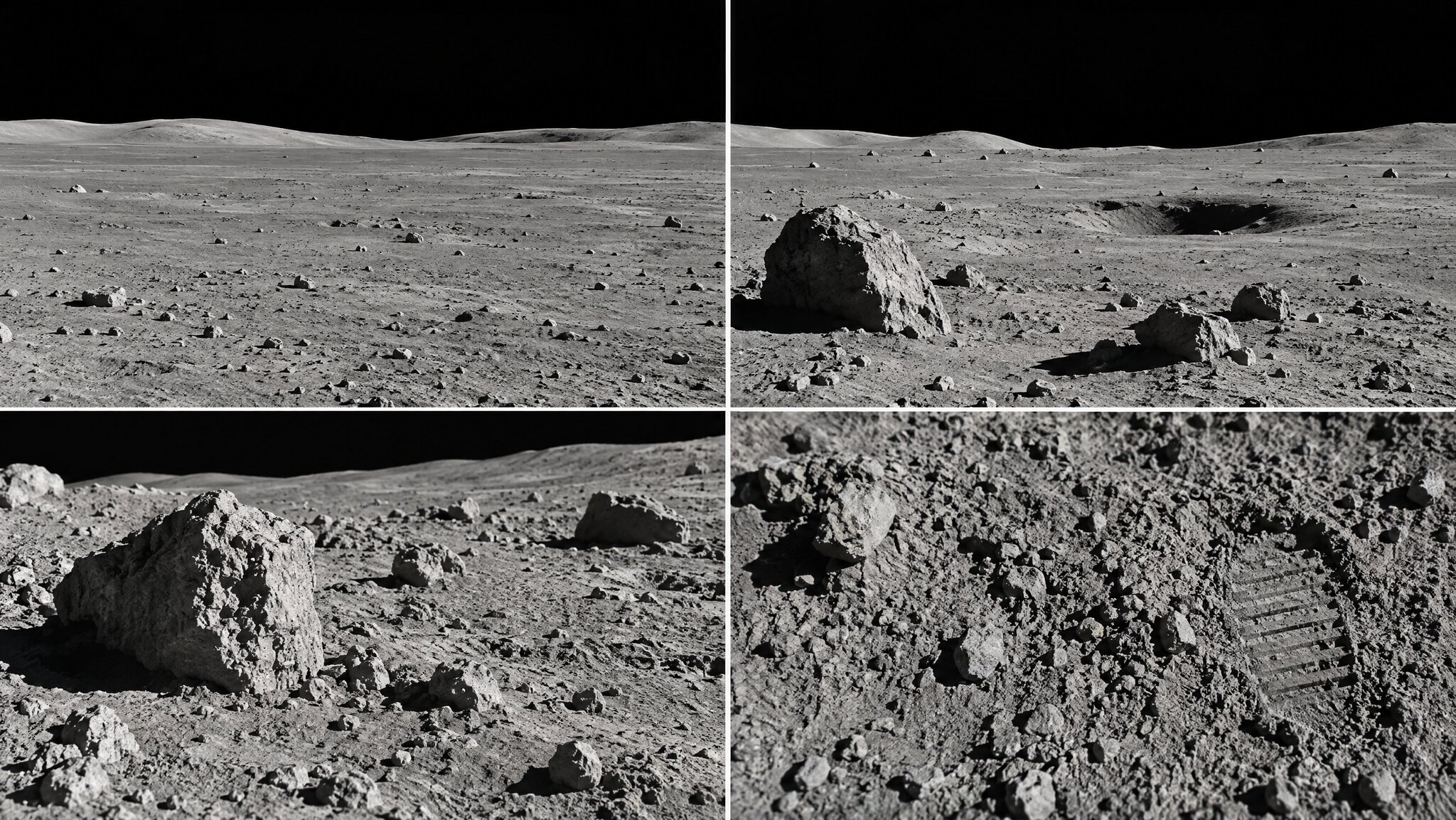
Four views of a grey lunar landscape under a black sky, from a wide plain down to a close-up of a boot print in the dust
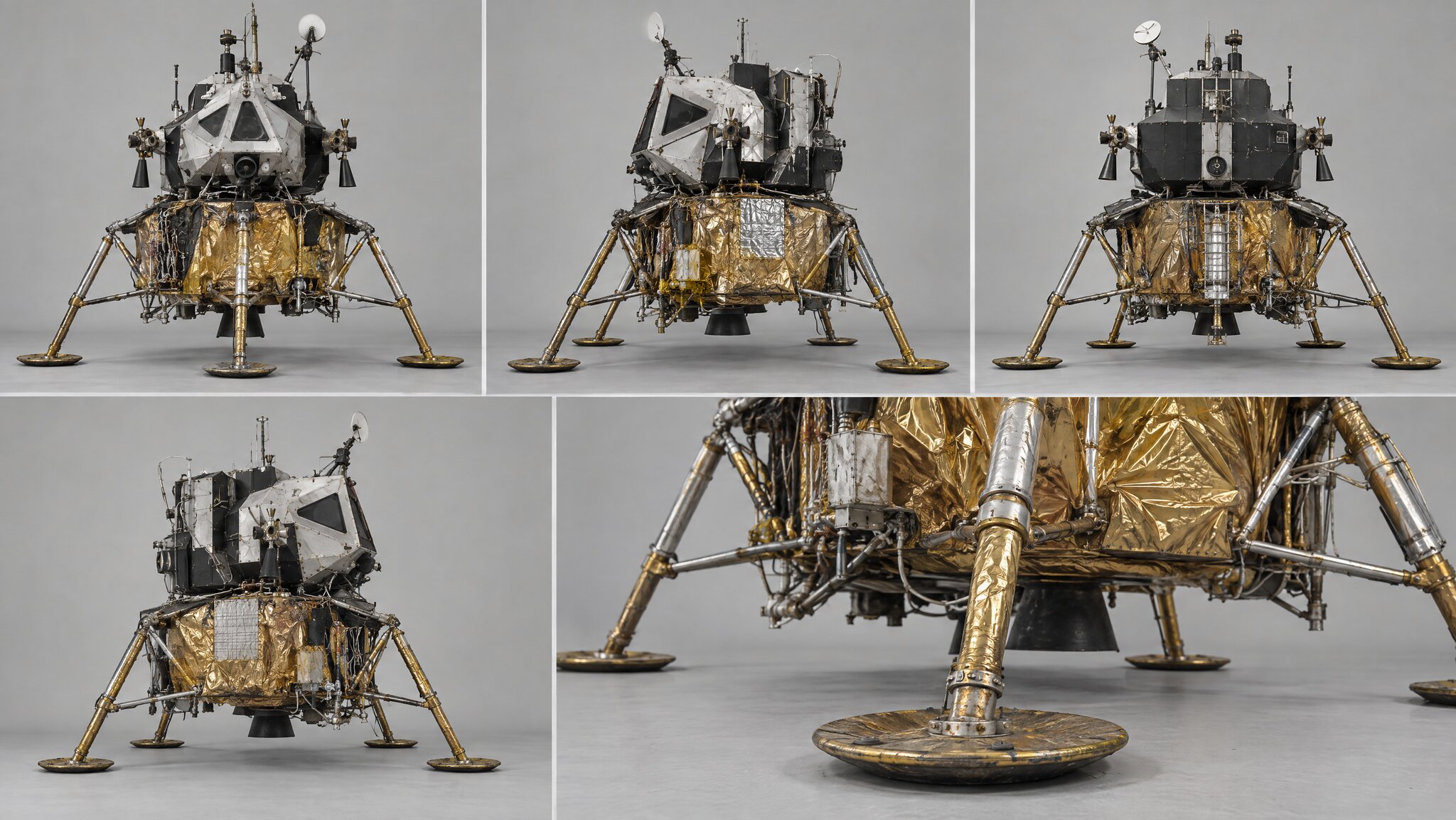
Five-view reference sheet of a gold-foil lunar module on four landing legs, with a close-up of a landing pad
This one is a single wide establishing shot instead of a sheet.
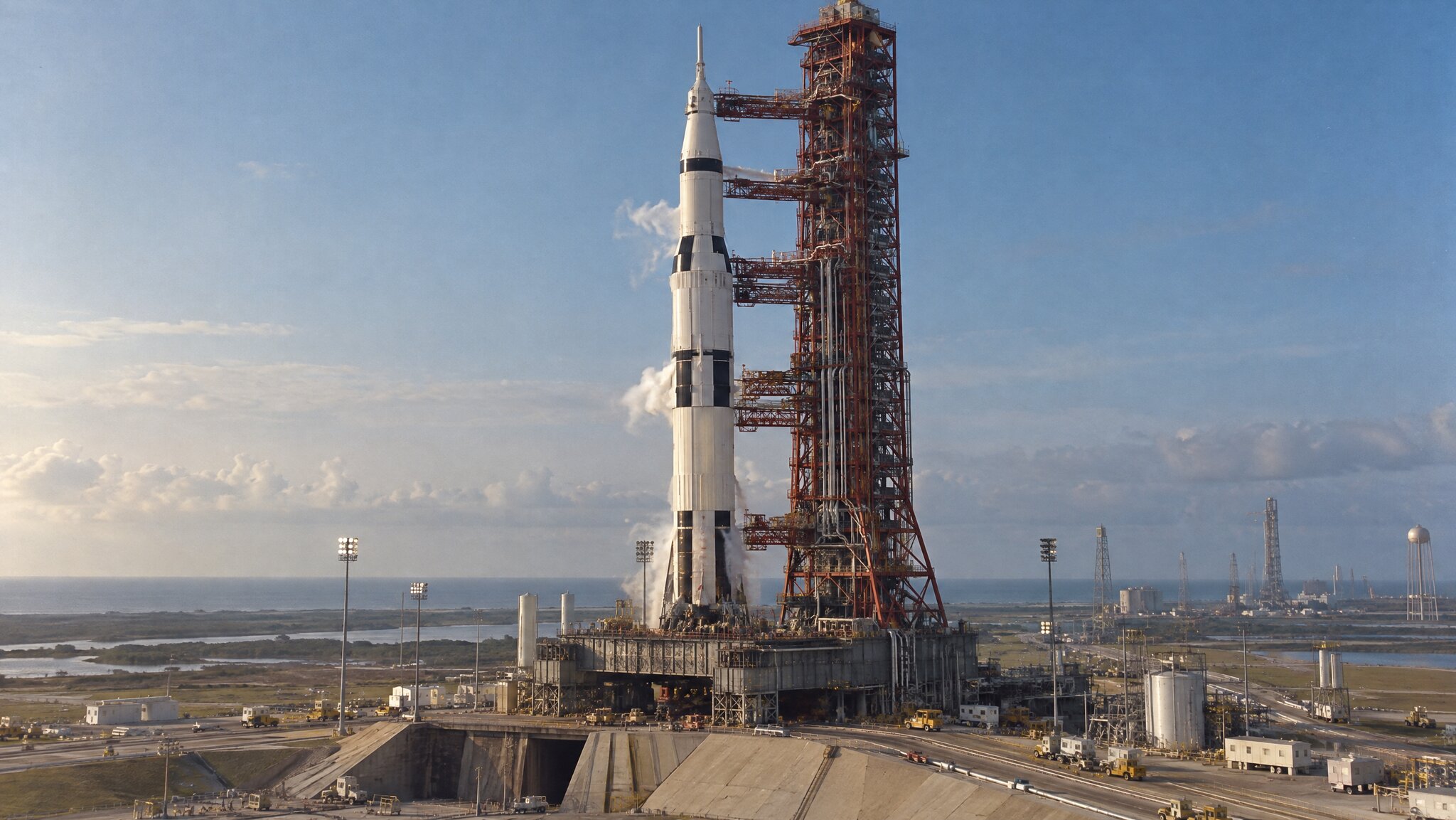
A tall white and black launch vehicle venting vapor beside a red steel tower at a coastal launch complex in early morning light
Technical reference sheet: lightweight lunar exploration vehicle (rover). Four distinct views on one canvas — front, back, left side profile, and right side profile.
Vehicle design: extremely low, lightweight, skeletal, completely open. No roof, windshield, doors, or enclosed bodywork. Structure built around thin exposed aluminum chassis with visible mechanical joints, braces, cables, suspension arms, steering components, small equipment mounts, lightweight structural tubing.
Wheels: four large wheels at corners with wide spacing. Constructed from flexible metallic wire mesh with distinct woven texture and thin structural reinforcement around circumference. Not conventional rubber tires. Wheels appear lightweight and specialized for lunar terrain.
Seating: two simple lightweight seats mounted side by side near center. Thin tubular frames with woven fabric-like material. Upright, exposed seating position.
Equipment: antennas, camera equipment, communication devices, small rectangular equipment boxes, cables, brackets, control hardware, storage components, scientific instruments mounted directly onto frame. Prominent dish-shaped antenna toward front section.
Appearance: incredibly lightweight, almost improvised. Like collapsible aluminum exploration buggy designed for minimum mass. Skeletal frame fully exposed. No smooth body panels, no aerodynamic shape, no glossy automobile surfaces, no modern dashboard.
Materials and finish: thin aluminum tubing, welded joints, metallic wire mesh wheels, woven fabric seats, exposed mechanical components. Slightly worn metallic surfaces showing utilitarian construction. Late-1960s/early-1970s aerospace engineering aesthetic.
Lighting: neutral studio illumination, soft fill showing all details clearly. No harsh shadows obscuring geometry. Even exposure across all four views.
Composition: entire vehicle visible in each panel with ample empty space. Consistent scale and geometry maintained throughout. Vehicle centered. Front, back, and left and right side profiles show design from each angle.
Style: technical reference photography, neutral presentation, sharp focus on all components and materials, aerospace engineering documentation aesthetic. 1960s/early-1970s utilitarian design language. No interior cutaway, no exploded diagram. No text labels, arrows, captions, technical annotations. No humans, no landscape, no environment, no atmospheric effects, no dramatic lighting. No futuristic vehicle styling, no modern tires or electronics. Four distinct views maintain identical vehicle geometry and design throughout.
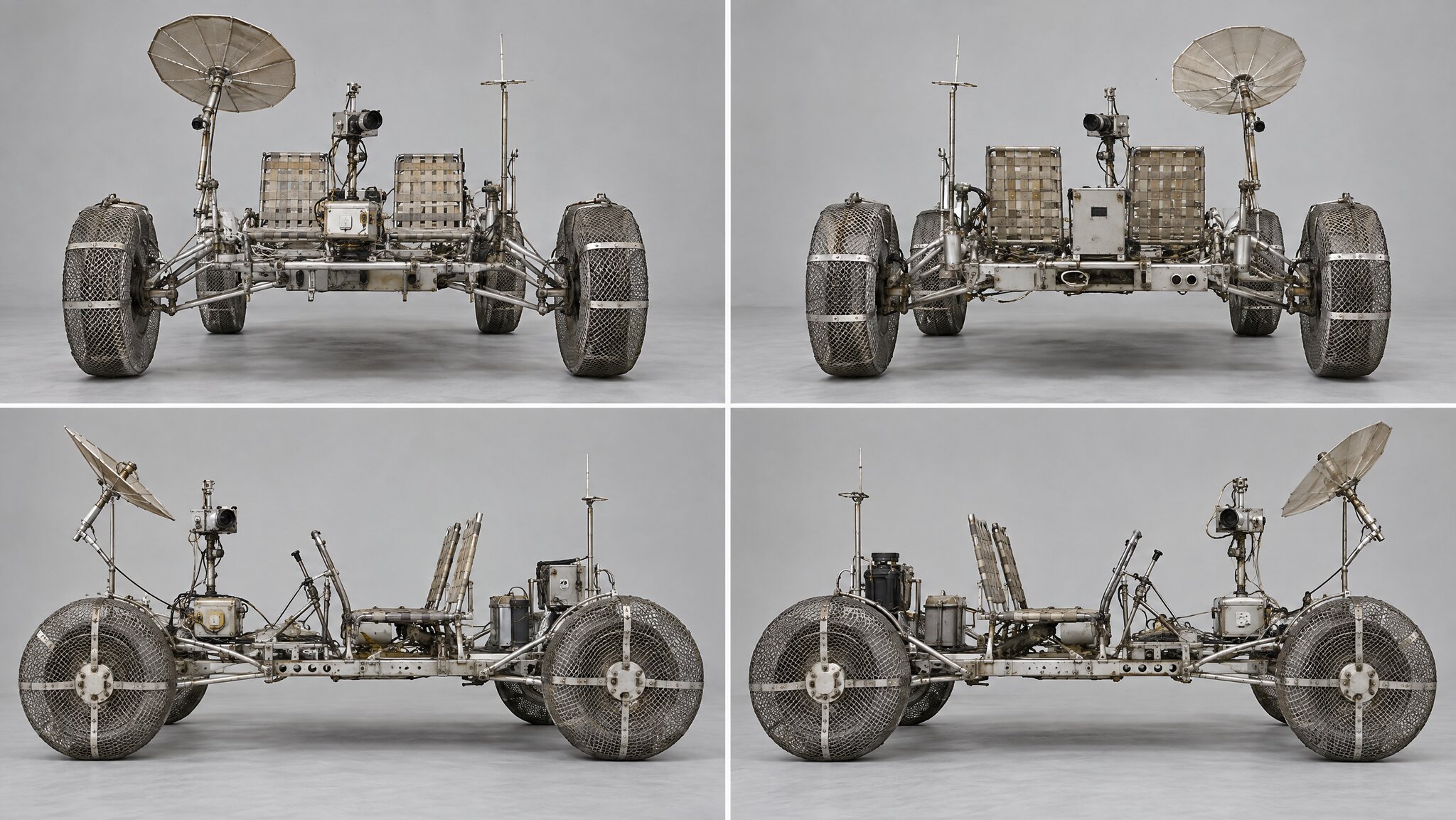
Four-view reference sheet of an open-frame lunar rover with wire-mesh wheels, two woven seats, and a dish antenna
And below are all the video prompts I used. Feel free to play around with them, tweak the details, and experiment with different styles to get the result you want.
I attached the five references, described each shot to Yapper Assistant in a sentence or two, and asked for a handheld 1969 look. It wrote the prompts below and ended each one with a note on which reference to lean on.
Every clip was generated with Seedance 2.5 at 16:9 and 480p, 8 seconds each. The prompts refer to the references by number, so attach them in this order:
- Reference image 1: the space rover
- Reference image 2: the launch station
- Reference image 3: the lunar module
- Reference image 4: the Moon surface
- Reference image 5: the astronaut
A single boot print in the lunar dust. Seedance 2.5, 16:9, 480p, 8 seconds.
An astronaut bounding toward the camera in low gravity. Seedance 2.5, 16:9, 480p, 8 seconds.
The lunar surface passing below a spacecraft window. Seedance 2.5, 16:9, 480p, 8 seconds.
Two angles of the same launch: one from right beside the pad, and one from far away through a long lens.
Liftoff from beside the launch structure. Seedance 2.5, 16:9, 480p, 8 seconds.
The same launch from far away. Seedance 2.5, 16:9, 480p, 8 seconds.
An astronaut climbing down the ladder of the lunar module. Seedance 2.5, 16:9, 480p, 8 seconds.
The rover crossing rough terrain in side profile. Seedance 2.5, 16:9, 480p, 8 seconds.
For the second rover shot, I wanted it to feel like another astronaut riding along was holding the camera. This clip uses only two references: the astronaut as image 1 and the Moon surface as image 2.
A close side shot of the astronaut driving the rover. Seedance 2.5, 16:9, 480p, 8 seconds, with two reference images.
Ready to stage your own Moon landing?
Open Yapper Assistant, build your reference sheets, and turn these prompts into your own shots with Seedance 2.5.


