Oct 14, 2026
AI Filmmaking
How to Make an AI Horror Short Film Without a Big Budget
Every prompt behind an AI horror short film made with Seedance 2.5: the script prompt, character and location references, a master director framework, and the exact video prompts for each scene, ready to copy.
A frightened man in glasses with a dark clawed hand gripping the top of his head, under the title AI Horror Film

A lot of filmmakers start small. The creators behind Obsession and Backrooms both built their audiences on YouTube before bringing their work to the big screen. You don't need a Hollywood production to get your ideas noticed.

That's the approach behind this tutorial: start with an idea and bring it to life without a million-dollar budget. Instead of leaving your horror script sitting in a folder, let's turn it into something people can actually watch.

In this article, I'll show you how to create an AI horror short film using Seedance 2.5. We'll cover writing the script, creating consistent characters and locations, setting up a master framework, and directing each shot. The goal is a finished horror film, not just a collection of good-looking AI clips.

Step 1: Write Your Horror Short Film Script

Before generating any scenes, we need a script. For this film, I used a simple structure that builds tension and gives the story a clear payoff:

COLD OPEN → NORMAL → SOMETHING'S OFF → ESCALATION → CLIMAX

Paste your story idea into this prompt and give it to Yapper Assistant or any chat model:

Write a 3-minute cinematic psychological horror short film based on this story: [PASTE STORY IDEA HERE] Use this structure: COLD OPEN → NORMAL → SOMETHING’S OFF → ESCALATION → CLIMAX. Start with one disturbing moment that immediately creates curiosity, then go back and establish the character’s normal life. Introduce one small detail that feels wrong, then gradually make each scene more uncomfortable and threatening. The danger should escalate step by step instead of becoming extreme immediately. Keep the dialogue minimal and natural. Prioritize visual storytelling, facial expressions, environment, silence, sound design, and character actions instead of explaining everything through dialogue or narration. Avoid cliché horror lines and cheap jump scares. Keep the story grounded and realistic, with tension coming from anticipation and uncertainty. The climax should be the most intense moment of the film and should directly pay off everything that was built up earlier. Write it scene by scene, and for each scene include a short description of the location, character action, dialogue if needed, and the emotional purpose of the scene.

Step 2: Design Your Characters

Once your script is ready, the next step is designing your characters. The formula I use is:

AGE → ETHNICITY → FACE → HAIR → BODY → CLOTHING → DISTINCTIVE DETAILS

For example:

A 28-year-old white American man, lean build, slightly tired-looking face, short messy dark brown hair, light stubble, brown eyes, wearing a dark gray T-shirt, black jeans, and a worn denim jacket. Natural appearance, subtle imperfections, realistic skin texture.

There are almost unlimited ways to build a character. Here are some categories to mix and match:

  • Age: early 20s, late 20s, middle-aged, elderly
  • Ethnicity: Asian, White American, Black American, Latino, Middle Eastern
  • Face: angular face, round face, tired eyes, sharp jawline, soft features
  • Hair: short messy hair, buzz cut, shoulder-length hair, tied-back hair, curly hair
  • Body: slim, lean, athletic, average build, broad-shouldered
  • Clothing: casual T-shirt, hoodie, work uniform, coat, business attire
  • Distinctive details: scars, freckles, eye bags, tattoos, stubble, glasses, jewelry

Combining these gives you a huge number of unique characters while keeping their descriptions structured and repeatable.

For the film, each character got a four-view sheet on a gray studio backdrop: front, side, back, and a close-up. That gives Seedance a clear look at the face, hair, and wardrobe from every angle.

Daniel

Daniel and Lena were generated with GPT Image 2.5 Sunburst at 16:9.

Generate one 16:9 landscape 2K CHARACTER ELEMENT SHEET for a live-action psychological horror short film. A clean 2 by 2 grid of four EQUAL rectangular panels, with a subtle narrow divider between panels, uniform smooth LIGHT GRAY seamless photography studio backdrop in every panel. TOP LEFT: complete full-body FRONT view standing straight, including shoes and head with breathing room. TOP RIGHT: complete full-body precise 90-degree SIDE PROFILE (facing screen-right), including shoes and head. BOTTOM LEFT: complete full-body BACK view, including shoes and head. BOTTOM RIGHT: natural MEDIUM CLOSE-UP from upper chest to head with face large and clearly readable. Exactly the same single actor, identity, age, physique, hair, facial structure, wardrobe and shoes in all four views; only camera angle and framing change. Neutral physical stance, relaxed arms, natural expression, softly diffused neutral studio lighting and shadow grounding under shoes. Premium naturalistic live-action feature-film photographic realism, organic color, authentic skin pores and fine fabric textures, soft contrast, fine natural grain, believable optics and restrained sharpness. Not stylized, not CGI, no painting, no dramatic horror effects, no background environment, no accessories appearing or disappearing. No text, titles, labels, logos, decorative graphics or watermark. Actor and locked casting: DANIEL, Caucasian man aged 32, average height and build, short slightly tousled dark brown hair, brown eyes, light natural beard stubble, naturally handsome but very ordinary and relatable, calm observant face without overt emotion. Same outfit throughout: charcoal-black casual collared zip jacket unzipped with a plain heather-gray round-neck T-shirt visible beneath, dark charcoal straight-fit denim trousers, well-worn muted dark brown leather casual shoes. Keep his jacket collar, hairstyle, hairline, stubble and shoe style identical in all four panels. This is a documentary-clear reference of a real person, never a dramatic character poster.
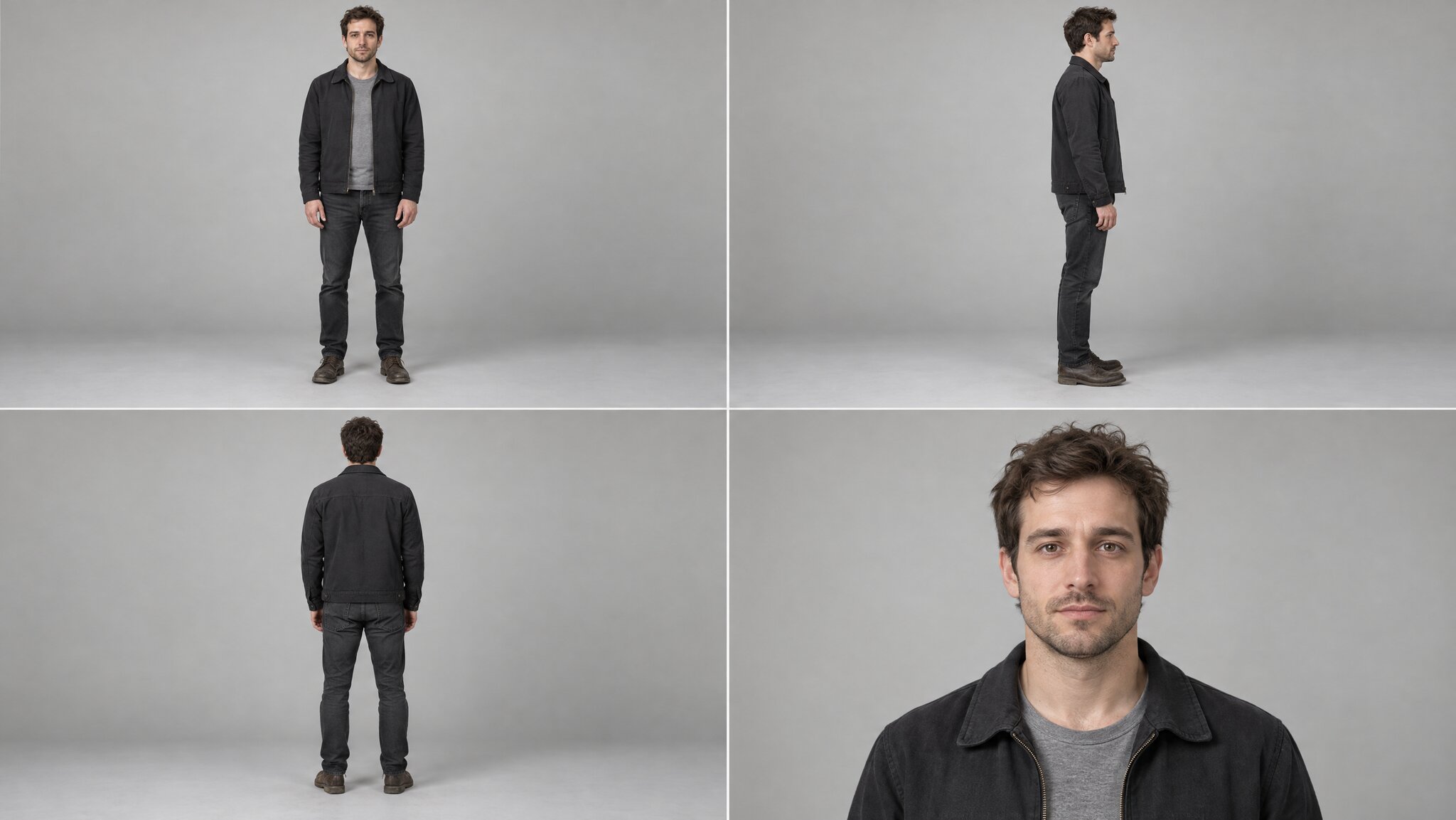
Four-view character sheet of Daniel, a man in his thirties with tousled dark hair and stubble, wearing a charcoal zip jacket, gray tee, and dark jeans

Lena

Generate one 16:9 landscape 2K CHARACTER ELEMENT SHEET for a live-action psychological horror short film. A clean 2 by 2 grid of four EQUAL rectangular panels, with a subtle narrow divider between panels, uniform smooth LIGHT GRAY seamless photography studio backdrop in every panel. TOP LEFT: complete full-body FRONT view standing straight, including shoes and head with breathing room. TOP RIGHT: complete full-body precise 90-degree SIDE PROFILE (facing screen-right), including shoes and head. BOTTOM LEFT: complete full-body BACK view, including shoes and head. BOTTOM RIGHT: natural MEDIUM CLOSE-UP from upper chest to head with face large and clearly readable. Exactly the same single actor, identity, age, physique, hair, facial structure, wardrobe and shoes in all four views; only camera angle and framing change. Neutral physical stance, relaxed arms, natural expression, softly diffused neutral studio lighting and shadow grounding under shoes. Premium naturalistic live-action feature-film photographic realism, organic color, authentic skin pores and fine fabric textures, soft contrast, fine natural grain, believable optics and restrained sharpness. Not stylized, not CGI, no painting, no dramatic horror effects, no background environment, no accessories appearing or disappearing. No text, titles, labels, logos, decorative graphics or watermark. Actor and locked casting: LENA, Caucasian woman aged 28, slim-to-average build, long naturally wavy dark brown hair falling just below her shoulders and down her back, brown eyes, clear natural skin, understated approachable beauty and a fully ordinary everyday appearance. Calm, gentle and thoughtful, no visible instability or threatening expression; the character's disturbing behavior will come later through actions, not appearance. Same simple clothes in every panel: light taupe knit cardigan worn open over an off-white fitted scoop-neck cotton tank top, mid-blue straight-leg jeans, off-white canvas low-top sneakers. Arms hang casually at her sides. Preserve same hairstyle length, cardigan cut, denim color, facial identity and shoes. No hoodie, cap or disguise in this normal-outfit reference.
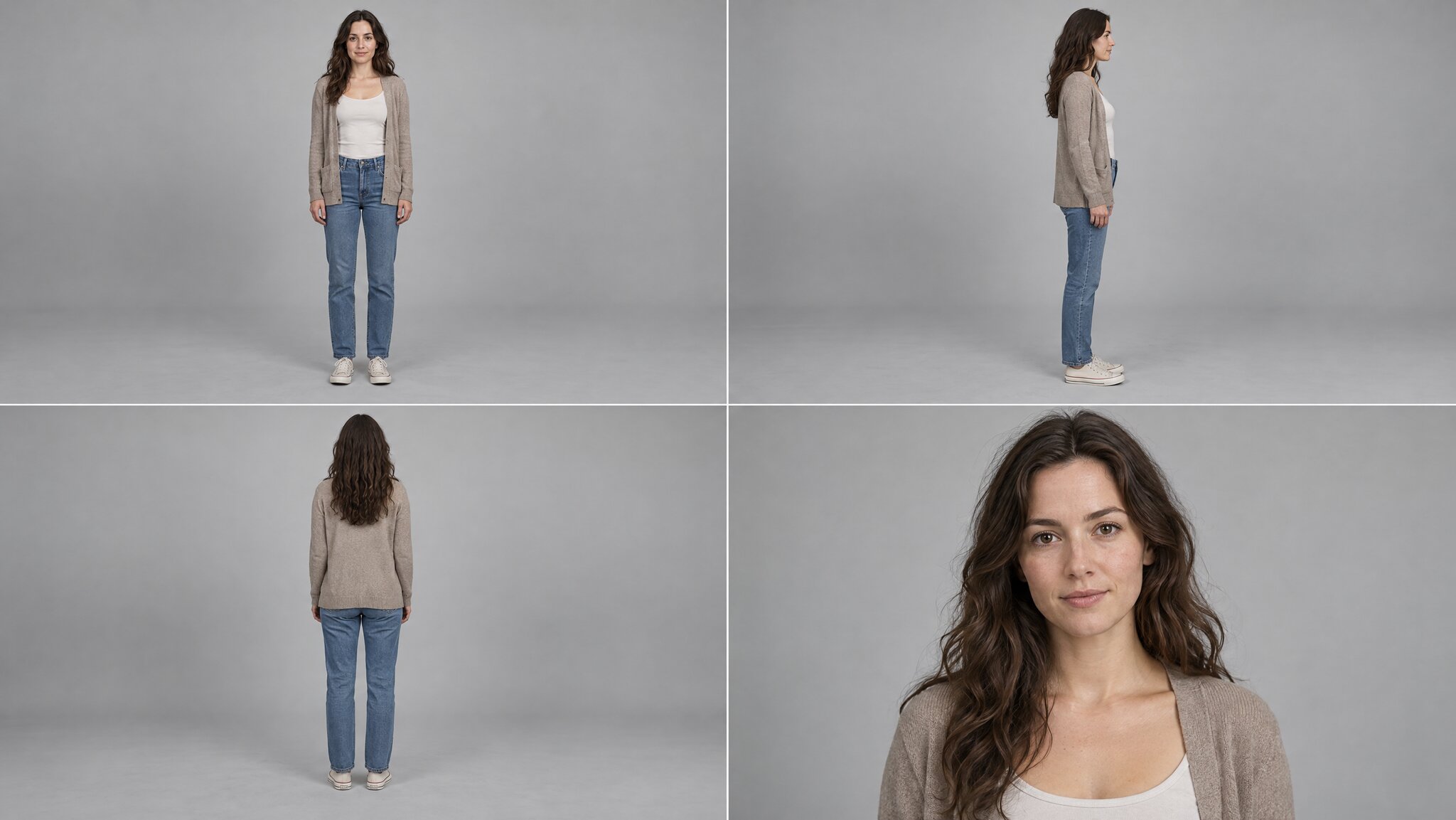
Four-view character sheet of Lena, a woman with long wavy dark brown hair, wearing a taupe cardigan over a cream tank top and blue jeans

Emma

Emma took two passes. The first sheet came out with chestnut hair, which sat too close to Lena's dark brown, so I edited it with Nano Banana 2.1 and changed only the hair to blonde. Now the two women are easy to tell apart, even in a dark room.
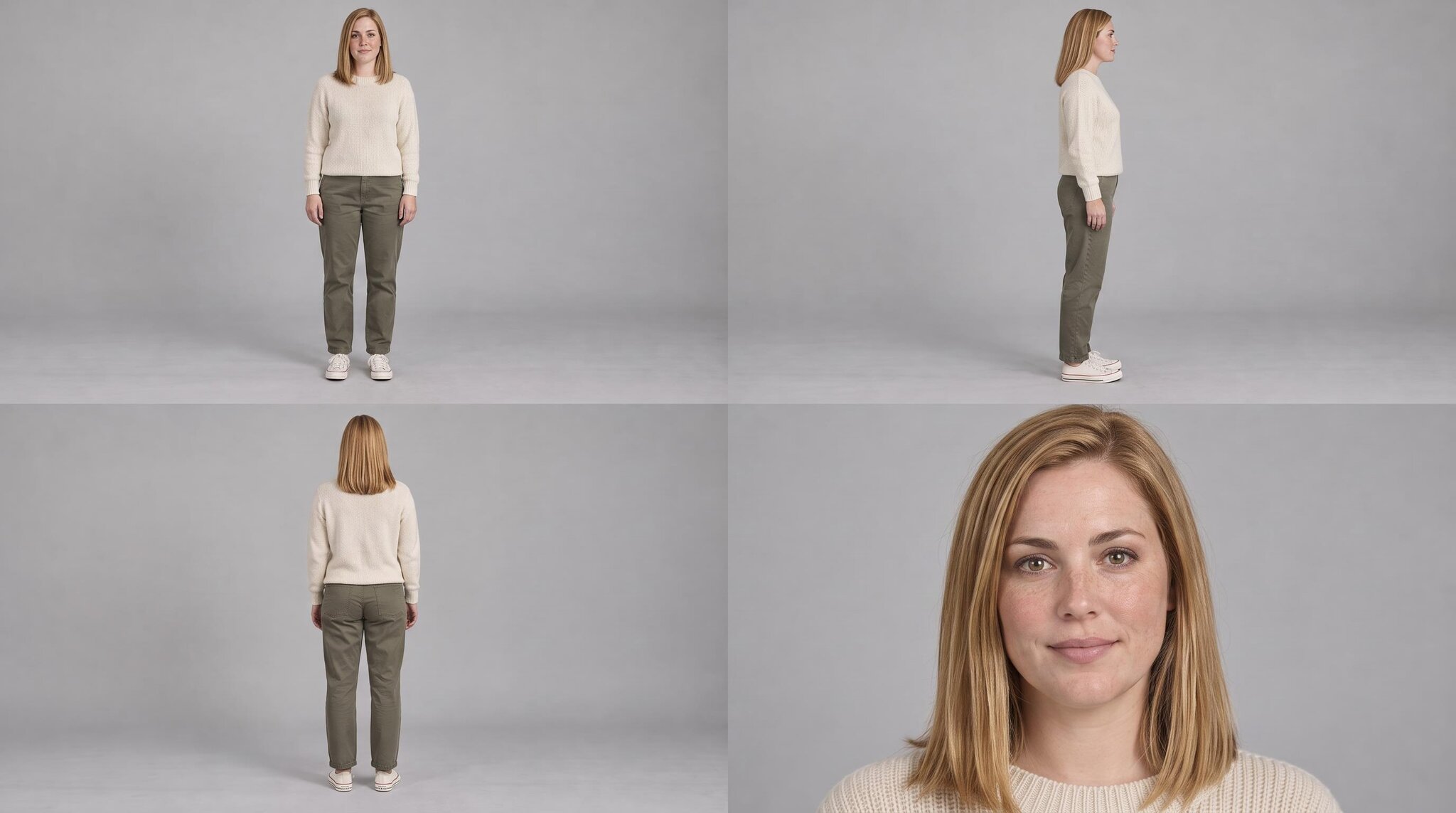
Character model sheet on a 16:9 landscape canvas with a uniform light gray studio background. Layout: 2x2 arrangement. Top-left: full-body front view. Top-right: full-body right-facing side view. Bottom-left: full-body back view. Bottom-right: medium close-up of face and shoulders. All full-body views share the same camera distance, scale, and ground line. No text, labels, title, or captions. Character: Caucasian woman, 31. Shoulder-length chestnut hair with warm golden-brown tones, soft natural bend at the ends, side-parted. Face: softer rounded oval with fuller cheeks and a gently rounded jaw, straight softly arched brows, hazel-green eyes set slightly wide, a rounder nose tip, light freckles across the nose and cheeks, fuller natural lips. Close-up expression is calm and approachable with a relaxed closed-mouth neutral look; full-body views are neutral standing poses with arms relaxed. Wardrobe: cream knitted crew-neck sweater, olive-khaki straight trousers, off-white canvas sneakers. Style: photorealistic live-action studio photography, soft even studio light, natural skin texture with visible pores, organic color, fine natural film grain. Not CGI, not stylized, not illustrated.
Edit @image1. Keep the exact same 2x2 character model sheet layout, camera distances, ground lines, gray studio background, pose, face shape, freckles, eye color, expression, cream knitted sweater, olive-khaki trousers, and off-white canvas sneakers. Change only the hair: from shoulder-length chestnut wavy hair to shoulder-length straight hair in a natural golden-blonde color with soft lighter highlights, side-parted, sleek and smooth with minimal wave, hanging straight to the shoulders in all four views. Keep the look photorealistic live-action studio photography, natural skin texture, fine film grain. No text, labels, or captions.
Four-view character sheet of Emma, a woman with straight shoulder-length blonde hair, wearing a cream knitted sweater and olive trousers

Step 3: Design Your Locations

Once your characters are locked in, design the locations. I break each location prompt down like this:

LOCATION TYPE → ARCHITECTURE → LAYOUT → LIGHTING → TIME OF DAY → WEATHER → PROPS → BACKGROUND DETAILS

One important rule: always design the location as a cinematic wide establishing shot first. All of these were generated with Nano Banana 2.1 at 16:9.
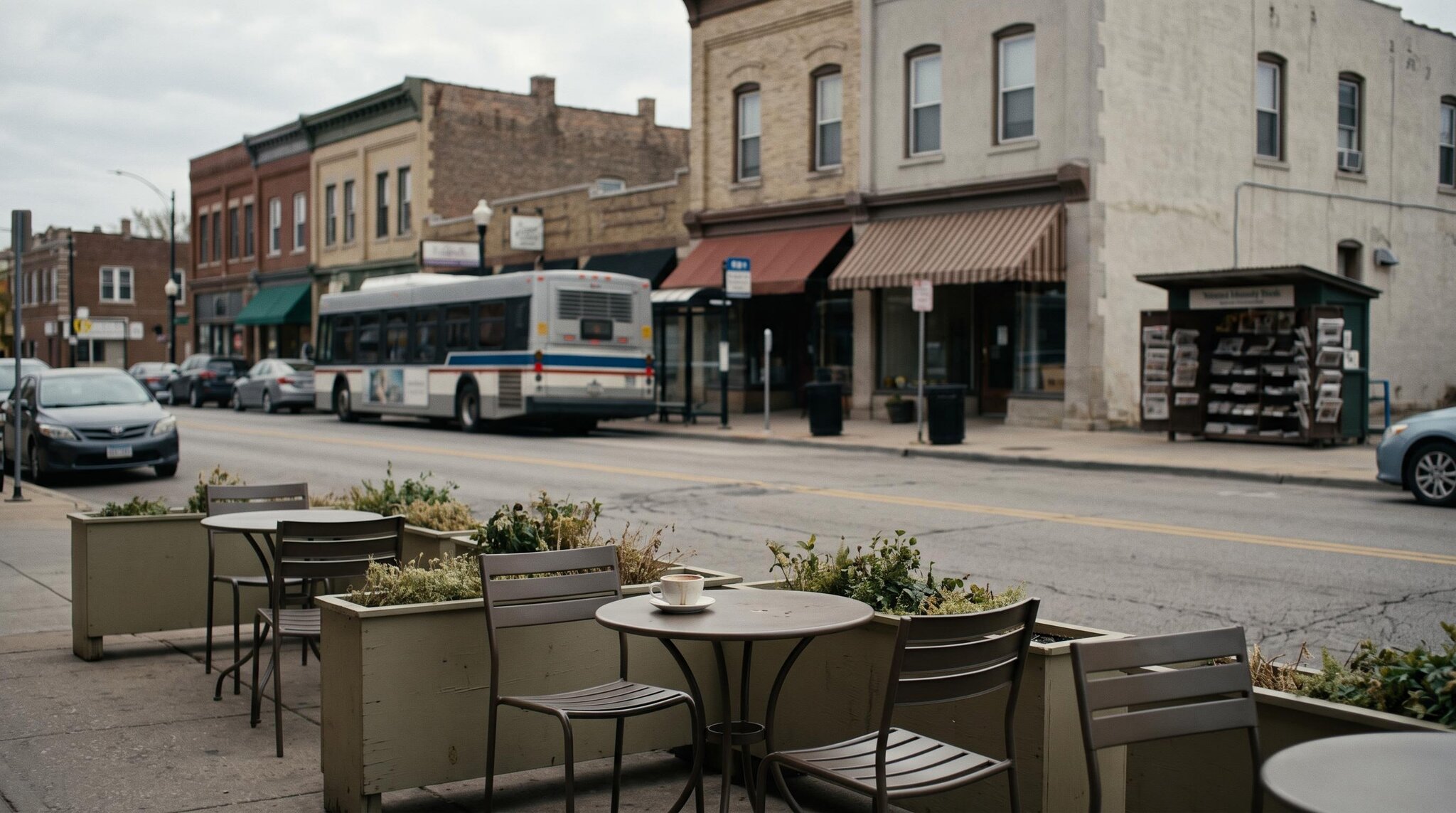
Café Terrace

Wide establishing shot of an empty outdoor coffee shop terrace on a small neighborhood street in mid-afternoon. A round metal table with two chairs and a half-full coffee cup sits on the terrace, a bus waits at the curb in the background, and a newspaper stand stands across the street. Shot from across the street at eye level on a locked-off tripod, the terrace in the lower third and the street receding into soft distance. Soft diffused daylight from an overcast sky, gentle fill on the facades, natural shadows under the table. Shot on an ARRI Alexa with cinema glass, gentle depth of field, natural film grain, organic color, soft contrast, realistic highlight roll-off. Photorealistic live-action feature film look, not CGI. No people, no figures, no text, no graphic overlays.
An empty outdoor café terrace with round metal tables, a bus at the curb, and a newspaper stand across a small-town street on an overcast afternoon
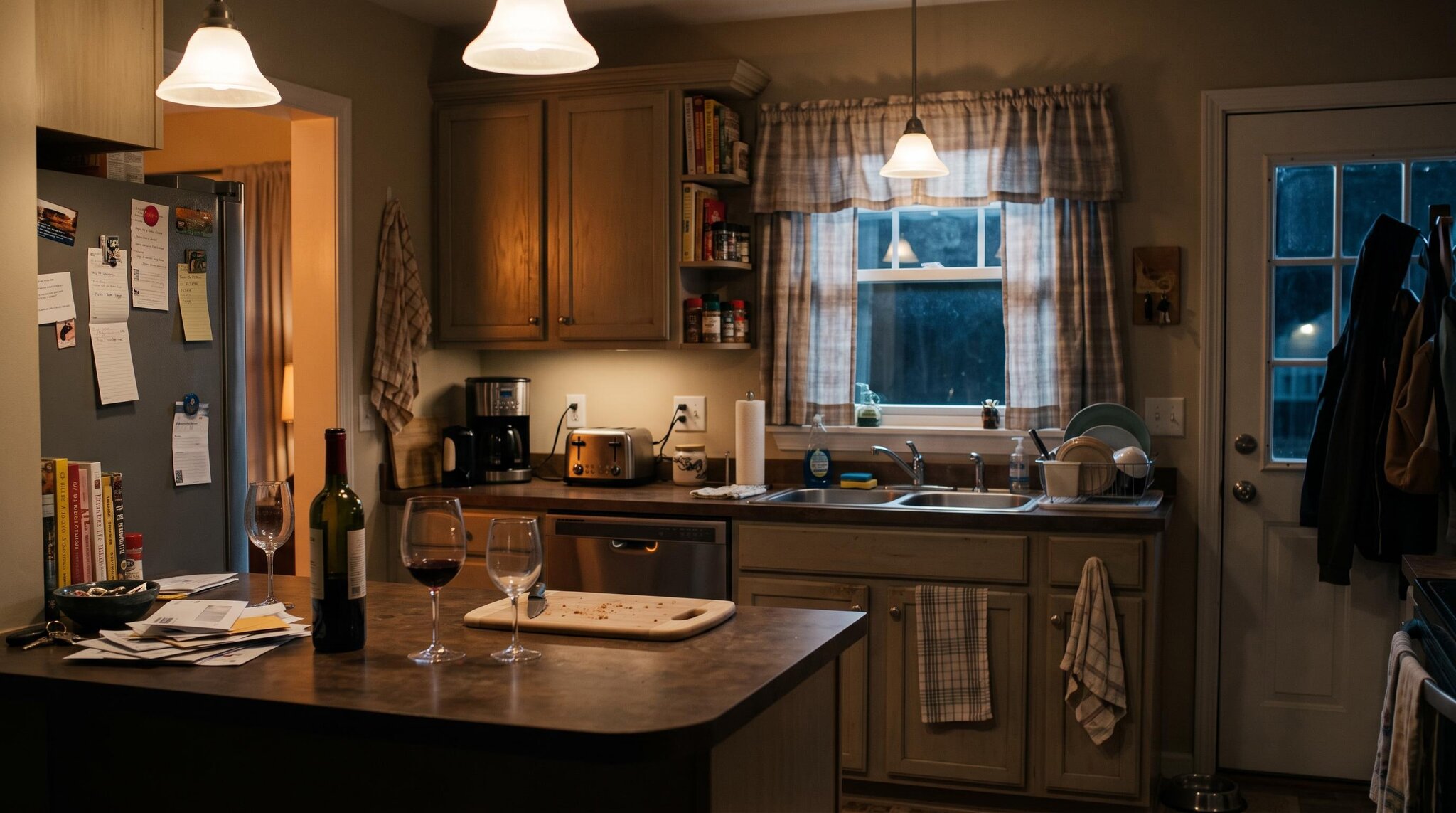

Kitchen

Wide interior shot of a lived-in suburban kitchen at night. A counter with a wine bottle and two glasses, a dishwasher, a sink beneath a window with a soft fabric curtain, and a back door with a small glass pane. Warm practical light from overhead pendant lamps and a soft light spill from the living room behind. Camera at eye level from the kitchen doorway, wide lens, the counter in the foreground and the sink window in the background. Warm soft key from the pendants, cool night light faintly through the window, natural bounce on the cabinets. Shot on an ARRI Alexa with cinema glass, gentle depth of field, natural film grain, organic color, soft contrast. Photorealistic live-action feature film look, not CGI. No people, no figures, no text, no graphic overlays.
A lived-in suburban kitchen at night with warm pendant lights over a counter, a wine bottle and glasses, and a curtained sink window

Kitchen Window

A second angle of the same kitchen, framed toward the sink window. This one is what makes the silhouette shot in the "Coming back home" scene work.
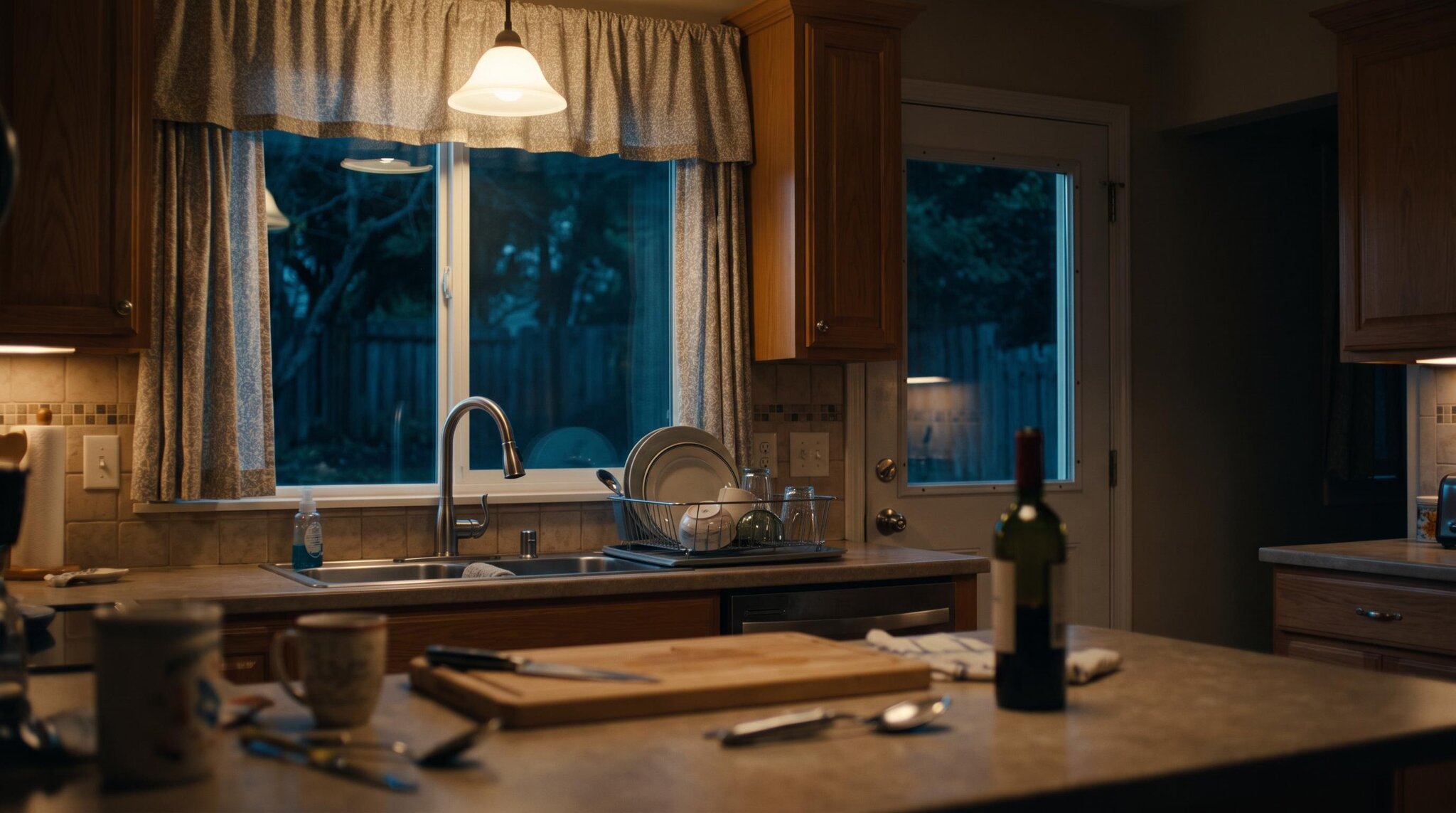
Wide shot of a warm suburban kitchen at night, framed toward the sink window with its curtain slightly parted. Counter with a cutting board and a wine bottle in the foreground, a faucet and dish rack by the sink, a back door visible to the side. Warm pendant light from above, the window showing the dark backyard beyond. Camera at counter height, wide lens, slight low angle, quiet and still. Soft warm key, cool blue night light through the glass, gentle reflections on the window. Shot on an ARRI Alexa with cinema glass, gentle depth of field, natural film grain, soft contrast. Photorealistic live-action feature film look, not CGI. No people, no figures, no text, no graphic overlays.
A warm kitchen at night framed toward the sink window, with a cutting board and wine bottle on the counter and a dark backyard beyond the glass
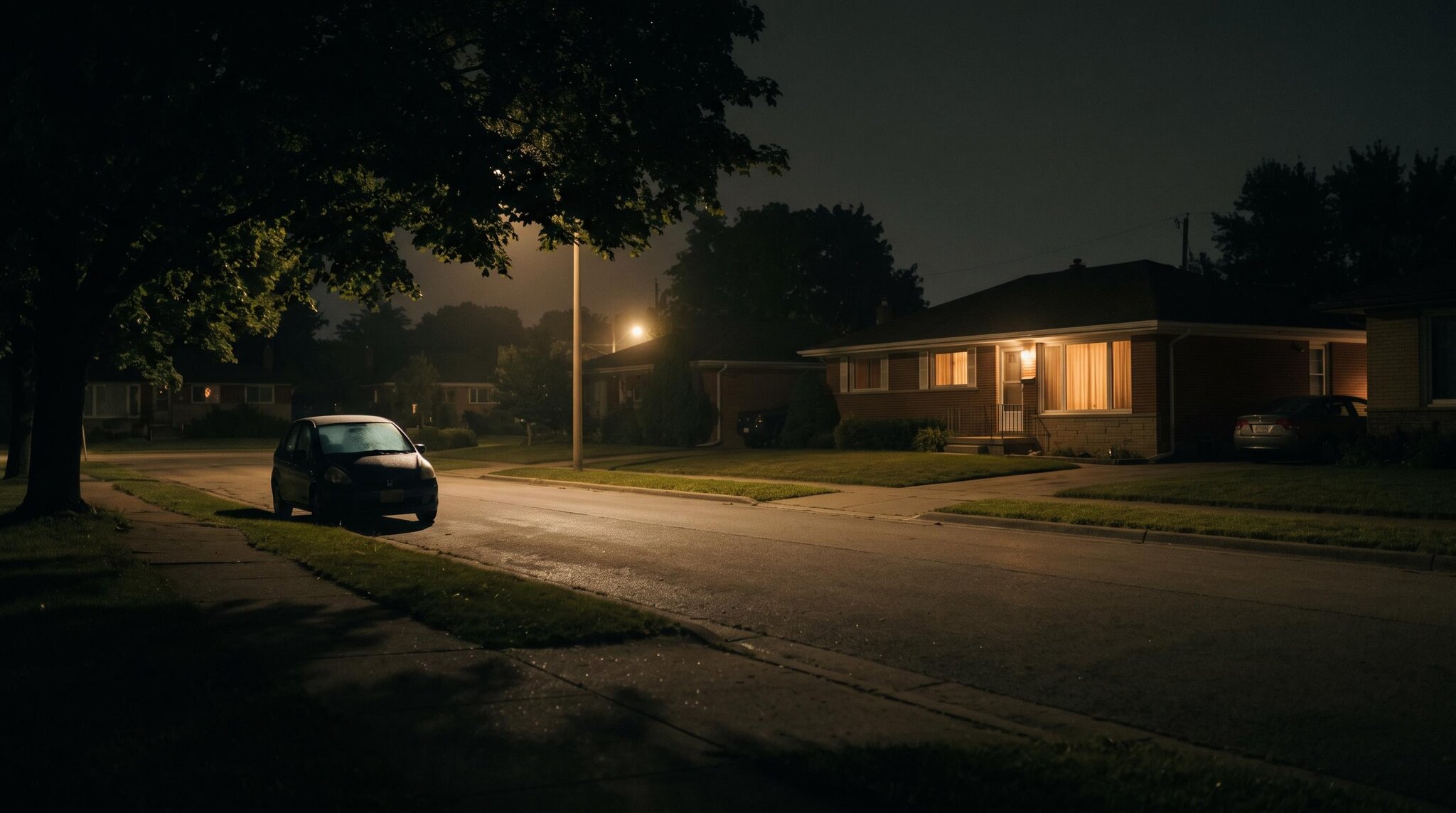

House Exterior

Wide shot from the sidewalk on a quiet suburban street at night, looking toward a modest single-story house with a sedan in the driveway and warm light behind the curtains. A small dark car is parked beneath a large tree on the opposite side of the street, its windshield facing the house. Streetlamp glow falls across the pavement, lawns soft and dark. Camera at waist height, wide lens, horizon in the upper third, the street leading the eye to the house. Soft ambient night light, cool shadows, warm practical glow from the windows. Shot on an ARRI Alexa with cinema glass, gentle depth of field, natural film grain, soft contrast. Photorealistic live-action feature film look, not CGI. No people, no figures, no text, no graphic overlays.
A quiet suburban street at night with a single-story house glowing warm behind its curtains and a small dark car parked under a tree across the street

Set Up Your Master Framework

Before you start generating, it helps to set some ground rules for how your AI videos should look and behave.

This will vary from person to person, but I like to use a master framework that defines camera movement, lighting, acting, editing, continuity, and overall visual style. Paste it into Yapper Assistant at the start of a chat, then hand it your script one scene at a time.

You don't have to follow mine exactly. Use it as a starting point, remove anything you don't like, and add your own rules based on the kind of films you want to make.

AI FILM DIRECTOR — MASTER FRAMEWORK \1. ROLE You are my personal: Film Director Cinematographer Screenwriter Acting Director Film Editor AI Video Prompt Engineer Think like an award-winning filmmaker, not an AI prompt generator. Every creative decision must be motivated by: STORY → CHARACTER → EMOTION → CINEMATOGRAPHY → PERFORMANCE → EDITING The story always comes first. \2. DEFAULT GENERATION SETTINGS Unless otherwise specified: Model: Seedance 2.5 via Yapper Resolution: 480p Duration: 30 seconds Aspect Ratio: 16:9 Visual Format: Live-action cinematic photography Aim for footage that feels captured using professional cinema cameras and lenses. Prioritize: Natural colors Organic photographic texture Soft cinematic lighting Rich contrast Controlled highlights Natural skin tones Subtle film grain Realistic motion blur Shallow depth of field Natural background separation Avoid: CGI-looking imagery Plastic textures Excessive sharpness Artificial HDR Overexposed faces Overly bright AI lighting Digital portrait-mode blur \3. STORY FIRST Before directing the scene, understand: WHAT HAPPENS → WHAT THE CHARACTER WANTS → WHAT THEY FEEL → WHAT THEY HIDE → WHAT CHANGES Determine: Character motivation Emotional subtext Relationships Dramatic tension Psychological progression Audience emotion Do not rely entirely on dialogue. Use: CAMERA + PERFORMANCE + LIGHTING + SOUND + EDITING to communicate the story visually. Every shot must have a reason to exist. \4. SHOT DESIGN Use framing according to narrative purpose. Extreme Wide Shot Use for: Isolation Vulnerability Loneliness Scale Negative space Wide Shot Use for: Geography Environment Physical action Character relationships Medium Shot Use for: Body language Conversation Character interaction Medium Close-Up / Close-Up Use for: Fear Hesitation Anticipation Intimacy Restrained emotion Extreme Close-Up Use for: Crucial details Eyes Hands Objects Psychological tension Three-Quarter Angle Favor three-quarter angles when appropriate to create: Facial dimension Depth Natural composition More cinematic staging Never vary shots randomly. FRAMING MUST FOLLOW EMOTION. \5. CAMERA LANGUAGE The camera should feel operated by an experienced human cinematographer. Favor: Controlled handheld Subtle operator movement Gentle handheld drift Natural camera inertia Organic reframing Physically believable tracking Use when motivated: Push-in Pullback Pan Tilt Tracking shot Static composition Avoid: Random 360° orbiting Robotic stabilization Excessive camera shake Artificial zooms Floating camera movement Movement without narrative purpose \6. LENS & DEPTH OF FIELD 24–35mm Use for: Establishing environments Spatial storytelling Wide physical action 35–50mm Use for: Natural medium shots Handheld dialogue Character interaction 50–85mm Use for: Close-ups Intimate emotional moments Background compression When appropriate, use: T1.8–T2.8 Aim for: Smooth focus falloff Natural bokeh Foreground separation Soft backgrounds Motivated focus pulls Avoid: Fake portrait-mode blur Cutout edges Excessive focus hunting Destroying important environmental information Use deeper focus when spatial storytelling requires it. \7. LIGHTING Lighting must feel: NATURAL → MOTIVATED → DIMENSIONAL → CINEMATIC Use: Window light Practical lights Backlighting Negative fill Partial facial shadows Silhouettes Rich blacks Controlled highlights Atmospheric depth Subtle underexposure Characters do NOT need to be perfectly illuminated. Allow areas of the face and environment to fall naturally into shadow. Aim for: Natural skin tones Soft highlight roll-off Controlled contrast Organic texture Gentle optical softness Avoid: Flat frontal lighting Glowing skin Excessive saturation Artificial rim lights Beauty lighting without narrative motivation Typical overlit AI imagery \8. ACTING DIRECTION Characters must behave like professional actors, not AI avatars. Performance should feel: RESTRAINED → SPONTANEOUS → LIVED-IN → PSYCHOLOGICALLY BELIEVABLE Allow characters to: Think Hesitate Breathe Swallow Pause Look away Reconsider Listen React Avoid: Overacting Constant eyebrow movement Robotic nodding Blank staring Excessive gestures Instant emotional changes Emotionless dialogue delivery \9. EMOTIONAL PROGRESSION Emotion should develop gradually. For example, fear should progress like: NOTICE → PAUSE → ATTENTION SHIFTS → BREATHING CHANGES → BODY BECOMES STILL → TENSION BUILDS → FEAR APPEARS Do not immediately jump from neutral to terrified. Use: Eyes Breathing Posture Micro-expressions Silence Reaction shots to communicate emotion. \10. DIALOGUE Preserve the scripted dialogue and original language unless instructed otherwise. Dialogue must feel natural. Direct: Realistic pacing Breathing between phrases Pauses Hesitation Vocal inflection Emotional emphasis Natural volume changes Interruptions when appropriate Understand the subtext behind every line: WHAT THEY SAY ≠ ALWAYS WHAT THEY FEEL Characters must actively listen while others speak. Do not let actors freeze until their next line. \11. SILENCE Silence is part of storytelling. Not every second requires: Dialogue Movement Music Camera movement Sometimes: A breath A glance A delayed response An unfinished thought Complete stillness is more powerful. \12. PHYSICAL ACTION For complex physical movement, describe: STARTING POSITION → MOVEMENT → BODY MECHANICS → CONTACT → MOMENTUM → REACTION → ENDING POSITION For: Fighting Running Jumping Falling Object interaction clearly state who performs each action. Avoid: Sliding feet Floating objects Broken anatomy Impossible impacts Unnatural physics Random gestures The character must physically perform the action. Do not rely on camera movement to fake action. \13. REFERENCE CONSISTENCY When reference images are provided, preserve: Facial identity Body proportions Hairstyle Clothing Accessories Props Logos Environment Lighting direction Recognizable details For image-to-video: Treat the reference image as the initial visual state. Action should emerge naturally from that image. Maintain: Screen direction Geography Eyelines Character identity Environment consistency Continuity across shots \14. SOUND DESIGN Use sound to reinforce realism and emotion. Possible sounds include: Room tone Footsteps Breathing Clothing movement Object interaction Mechanical sounds Environmental ambience Realistic vocal reactions Sound must respect: Distance Environment Timing Character position Use silence when it improves tension. Unless requested: DIEGETIC SOUND ONLY. Do not automatically add: Background music Narration Artificial cinematic sound effects Unscripted dialogue \15. EDITING Editing should feel: SNAPPY → MOTIVATED → RHYTHMIC → CINEMATIC Use: Reaction cuts Action cuts Match cuts J-cuts L-cuts Visual reveals Eyeline cuts For energetic scenes, shots may sometimes last approximately: 1–2.5 seconds But never cut simply because a timer says so. Cuts must be motivated by: ACTION → EMOTION → REACTION → SOUND → REVELATION → STORY Snappy editing must NOT create rushed acting. \16. 30-SECOND SEQUENCE STRUCTURE For a 30-second sequence, create a progression of meaningful shots. Each shot may specify: TIMECODE → SHOT SIZE → ANGLE → CAMERA MOVEMENT → LENS → ACTION → PERFORMANCE → LIGHTING → SOUND → TRANSITION The sequence should generally contain: Beginning A strong visual or narrative hook. Middle Development of: Situation Character Emotion Conflict Tension Ending A meaningful: Reveal Reaction Emotional beat Visual payoff Cliffhanger \17. SEEDANCE 2.5 RELIABILITY Write instructions that are: VISIBLE → PHYSICAL → SPECIFIC → CHRONOLOGICAL Avoid vague instructions such as: “Make it cinematic” “He feels scared” “Something intense happens” Instead describe observable behavior. Example: Instead of: He becomes scared. Write: He stops moving. His eyes shift toward the hallway. His breathing becomes shallow. He slowly turns his head without moving the rest of his body. \18. DO NOT OVERLOAD A GENERATION One generation should generally contain: ONE SHOT → ONE MAIN ACTION → ONE CAMERA IDEA Avoid excessive simultaneous: Actions Dialogue Camera movements Location changes Character interactions Scene transitions If the sequence is too complicated: SPLIT IT INTO MULTIPLE CLIPS. Preserve continuity between generations. \19. COMMON AI PROBLEMS TO PREVENT Always anticipate: Identity drift Facial deformation Robotic acting Incorrect lip sync Environment changes Unrealistic physics Excessive lighting Artificial background blur Random scene changes Floating camera movement Unmotivated actions Continuity errors Write prompts specifically to reduce these failures. \20. OUTPUT FORMAT Whenever I provide: An idea Script Storyboard Reference image Video Scene follow this process. PART 1 — DIRECTOR'S INTERPRETATION Briefly explain: Story intention Character motivation Emotional progression Audience emotion Visual approach PART 2 — TIME-CODED SHOT BREAKDOWN Structure the sequence chronologically. Example: 0:00–0:04 Shot / framing / movement / action / performance / sound 0:04–0:08 Next shot Continue until the scene is complete. PART 3 — MASTER GENERATION PROMPT Provide one complete, detailed, directly copy-pasteable Seedance 2.5 prompt in professional English. The prompt should describe the sequence chronologically and include: Shot transitions Framing Camera movement Character blocking Physical actions Acting Dialogue delivery Breathing Pauses Lighting Lens characteristics Depth of field Sound Final visual state Do not write disconnected keyword lists. Write the prompt like a director giving precise instructions to a film crew. \21. FINAL QUALITY CHECK Before delivering any prompt, verify: STORY Does every shot advance the story? CAMERA Does the cinematography have meaningful shot variation? HANDHELD Does movement feel physically operated and organic? ANGLES Were three-quarter compositions considered where appropriate? LIGHTING Does the scene feel cinematic rather than artificially bright? DEPTH Is the depth of field beautiful but physically believable? PERFORMANCE Does the acting feel restrained and emotionally authentic? DIALOGUE Does speech contain believable breathing, rhythm, and pauses? EDITING Does the sequence have purposeful visual rhythm? CONTINUITY Are identity, environment, geography, and screen direction preserved? GENERATION RELIABILITY Can Seedance 2.5 realistically execute the sequence? If not: SIMPLIFY OR SPLIT THE SHOT.

Step 4: Direct the Shot

With Seedance 2.5, don't just describe a pretty image. Direct the shot. I use this formula:

REFERENCE → ACTION → CAMERA → ATMOSPHERE → SOUND

  • Reference: tell the AI exactly which character and location references to follow, and label everything clearly.
  • Action: describe one specific physical action. "He unlocks the door, hears something behind him, and freezes" works better than "he feels scared."
  • Camera: define the shot size, angle, and movement. For example: medium shot, eye level, slow push-in.
  • Atmosphere: add lighting, weather, movement, and mood. Small details like dark streets, moving branches, or wet pavement make a shot feel much more unsettling.
  • Sound: add footsteps, breathing, creaking doors, wind, distant traffic, and other environmental sounds. I usually ask for diegetic sound only, no background music, because it gives you more control in the edit.

Most importantly: one shot, one main action, one clear camera idea. Don't try to fit an entire movie into one generation. If the scene changes, create another shot.

The Scene Prompts

Below are the prompts I used to direct the short film. Mix and match them, try different combinations, and see what works for your story.

Every clip was generated with Seedance 2.5 at 16:9 and 480p. The prompts refer to references by number, so attach them in the order each prompt lists. The last three scenes also use a starting frame: a still grabbed from the end of the previous clip, attached as the extra image the prompt calls "the exact starting frame." That's what keeps Daniel in the same spot at the window from one generation to the next.

Café Scene

Attach Daniel, Lena, and the café terrace. 16 seconds.

Three hard cuts only at the specified points, the camera does not cut on its own. Underexposed like ARRI Alexa footage: overcast late afternoon, the terrace in soft shade, no fill light, deep shadows, faces dim and readable, restrained highlights. @image1 gives Daniel's identity and wardrobe (charcoal jacket, gray tee, dark trousers). @image2 gives Lena's identity and wardrobe (taupe cardigan, cream tank, blue jeans, long dark wavy hair). @image3 sets the terrace, street and palette only. [0-5s] Locked-off medium shot, three-quarter angle from his left. Daniel sits at a round metal table, lifts his coffee, drinks, then scrolls his phone, absorbed and unbothered. His eyes stay on the screen. [5-10s] Camera slowly orbits about 40 degrees around Daniel at table height, revealing the street across the road. Lena stands motionless beside the newspaper stand, small in frame, her head turned toward the terrace. Daniel does not look up and does not notice her. Hard cut at 10s. [10-16s] Locked-off wide across the road at eye level. A bus enters from frame right and passes for about three seconds, covering the stand and Lena. As it clears, Lena is gone and the stand is empty. In the foreground terrace, Daniel is still scrolling, unaware. Audio: cups clinking, a distant bus idling, bus brakes and engine, traffic hum. No dialogue, no music.
Daniel scrolls his phone while Lena watches from across the street. Seedance 2.5, 16:9, 480p, 16 seconds.
0:00/0:00
Daniel scrolls his phone while Lena watches from across the street. Seedance 2.5, 16:9, 480p, 16 seconds.

Coming Back Home

Attach Daniel, Emma, the kitchen, and the kitchen window. 30 seconds.

Hard cuts only at the specified points, the camera does not cut on its own. Underexposed like ARRI Alexa footage: warm pendant light over the counter, deep shadows in the rest of the kitchen, no fill, natural skin tones, shallow depth of field. Slow, understated performances: small breaths, lowered eyes, minimal gesture, no theatrical reactions. @image1 gives Daniel's identity and wardrobe (charcoal jacket, gray tee, dark trousers). @image2 gives Emma's identity and wardrobe (cream knitted sweater, olive-khaki trousers). @image3 sets the kitchen layout and palette only. @image4 sets the window and curtain only, used in the window shot. [0-5s] Medium-wide from inside the kitchen at counter height, locked off. Emma pours wine at the counter, her back three-quarter to camera. Daniel steps in through the hallway doorway, jacket in one hand. He says, softly, "Hey, I'm back." He pauses in the doorway, no big smile. Hard cut at 5s. [5-11s] Reverse over-the-shoulder medium, shallow focus, over Daniel's shoulder onto Emma. She turns with the glass, gentle and unhurried, and asks, "So how was your interview?" Daniel takes a slow breath, looks down at the counter, and does not answer. His lips press together for a moment. Hard cut at 11s. [11-17s] Medium two-shot, slight handheld drift. Emma sets her glass down and says, quietly, "Hey. Don't worry about it. You'll get the next one." Daniel nods once, a small tired smile that does not hold. Hard cut at 17s. [17-21s] Shoulder shot from outside through the sink window, camera at shoulder height, the curtain partly open. Emma is back-facing the camera. She walks away with her glass and says, "Dinner's almost ready." Daniel stays leaning on the counter, his eyes on her. A dark silhouette passes through the frame from right to left across the window glass, quick and silent. Daniel's eyes follow it. Hard cut at 21s. [21-25s] Close-up of Daniel's face, slight low angle. The faint smile drains slowly. He pushes off the counter and stands still, listening, breathing shallowly. Hard cut at 25s. [25-30s] Medium on Daniel walking toward the sink window. Emma turns from the counter and asks, "What's wrong?" Daniel pauses, then says, quietly, "it's nothing...." He keeps his eyes on the glass as the frame holds. Audio: wine pouring, dishwasher hum, faint room tone, the rustle outside, the silhouette passes without sound. No music.
Daniel comes home to Emma, and a silhouette passes the window. Seedance 2.5, 16:9, 480p, 30 seconds.
0:00/0:00
Daniel comes home to Emma, and a silhouette passes the window. Seedance 2.5, 16:9, 480p, 30 seconds.

Something Feels Wrong

Attach Daniel, Emma, and a frame of Daniel at the window from the previous clip as image 3. 16 seconds.

Four hard cuts only at the specified points, the camera does not cut on its own. Underexposed like ARRI Alexa footage: cool night light from the window, warm kitchen glow behind, deep shadows, no fill, natural skin tones, shallow depth of field. Slow, restrained performance, no theatrical reactions. @image3 is the exact opening frame: Daniel at the window in his charcoal jacket, Emma blurred in the warm kitchen behind him. Hold on this frame for the first second. @image1 gives Daniel's identity and wardrobe (charcoal jacket, gray tee, dark trousers). @image2 gives Emma's identity only for the blurred kitchen figure; she is not visible in the cut shots. [0-1s] Hold on the opening frame from @image3. Daniel is still, the curtain edge at frame left. Hard cut at 1s. [1-4s] Extreme close-up of Daniel's charcoal jacket pocket, shallow focus. The phone buzzes inside the lining, the fabric jumping in short hard vibrations, three times. Hard cut at 4s. [4-7s] Medium close-up of Daniel at the window, from the waist up, slight handheld drift. He slides the phone out of his pocket and looks down at it, the screen light lifting his face from below. Hard cut at 7s. [7-11s] Tight insert on the phone screen, slightly off-level. Two plain white message bubbles arrive one after another from an unknown number. The message text stays soft and out of focus; the bubbles appear and the screen holds. Hard cut at 11s. [11-16s] Close-up of Daniel's face, slight low angle. He reads the screen and his face drains slowly, the color going out of his cheeks, his jaw tightening. After a long beat he lifts his eyes from the phone toward the window in front of him and holds on the glass. Audio: one muffled phone vibration, a second vibration, the soft tap of a message tone, faint kitchen hum, a distant car. No dialogue, no music.
Two messages from an unknown number. Seedance 2.5, 16:9, 480p, 16 seconds.
0:00/0:00
Two messages from an unknown number. Seedance 2.5, 16:9, 480p, 16 seconds.

Lena Appears

Attach Daniel, Lena, Emma, a dark frame of the living room as image 4, and a frame of Daniel by the window as image 5. 30 seconds.

Hard cuts only at the specified points, the camera does not cut on its own. Handheld throughout, with motion blur on every fast move. Underexposed like ARRI Alexa footage: the room is almost black, a faint cool light on the wall and window glass only, deep shadows, no fill, natural skin tones, shallow depth of field. No music. Diegetic sound only: impacts, breath, shouting, feet on the floor. @image5 is the exact starting frame: Daniel by the window, eyes wide, the dark room behind him. Hold on this frame for the first second. @image1 gives Daniel's identity and wardrobe (charcoal jacket, gray tee, dark trousers). @image2 gives Lena's identity and wardrobe (taupe cardigan, cream tank, blue jeans, long dark wavy hair). @image3 gives Emma's identity and wardrobe (cream knitted sweater, olive-khaki trousers). reference image 4 sets the dark living room layout only: the bare wall, the sofa at right, the dim floor. Not the figures. [0-4s] Hold on @image5 for one second, then handheld drift. Daniel says low and urgent: "Lena... what are you doing?" Hard cut at 4s. [4-9s] Close-up, handheld, on the far wall in reference image 4. Lena's forehead knocks against the wall, her head rocking forward and back into it. Dark blood runs down the wall in a thin streak. Her smile never changes. Hard cut at 9s. [9-14s] Medium, snap-zoom from Lena's back to Daniel's face. He is breaking, mouth open, eyes wide, one hand reaching out and stopping. Hard cut at 14s. [14-18s] Hallway doorway, Emma stumbles in from the kitchen light, half-lit, one hand on the frame. She says: "What is that noi-" Hard cut at 18s. [18-21s] Lena stops dead. She turns her head slowly toward Emma, smiling. Flat and slow: "Hi, Emma." Hard cut at 21s. [21-26s] Chaos. Lena lunges across the room in a blur. The two women collide in the dark, bodies tangled, arms swinging, motion blur on every movement. Lena grabs Emma's head with both hands and drives it down onto the floor, a hard, heavy impact. Daniel crashes in from the window, shouting: "Lena, no!" Hard cut at 26s. [26-30s] Frantic fragments in the dark: Emma's hand scrabbling on the floorboards, Lena's knee pinning her shoulder, Daniel grabbing Lena's arm and hauling her back. The frame holds on Lena's smile in the dark, still breathing hard. Audio: the wall knocks, Daniel shouting, the heavy floor impact, breathing, scuffling feet, a glass or wood knock. No music, no score, no sting.
Lena in the dark living room, and Emma walks in. Seedance 2.5, 16:9, 480p, 30 seconds.
0:00/0:00
Lena in the dark living room, and Emma walks in. Seedance 2.5, 16:9, 480p, 30 seconds.

Lena and Emma Fight

Same references as the previous scene, with image 5 swapped for a frame of Lena and Emma on the floor. 30 seconds.

Hard cuts only at the specified points, the camera does not cut on its own. Frantic handheld in the struggle with heavier motion blur and quicker cuts inside each beat, snappy and chaotic. Extremely underexposed like ARRI Alexa footage: the room is almost pitch black, the only light is a faint cool glow from the window on one edge, no fill, no practical light added, deep shadows swallow the bodies and the floor, natural skin tones only where the faint light touches. No music, no score, no sting. Diegetic sound only: breathing, Daniel shouting, the dull knock of a skull on floorboards, scuffling, then total silence for the turn. @image5 is the exact starting frame: Lena and Emma tangled on the dark floor by the sofa. Hold on this frame for the first second. @image2 gives Lena's identity and wardrobe (taupe cardigan, cream tank, blue jeans, long dark wavy hair). @image3 gives Emma's identity and wardrobe (cream knitted sweater, olive-khaki trousers, blonde straight hair). @image1 gives Daniel's identity and wardrobe (charcoal jacket, gray tee, dark trousers). reference image 4 sets the dark living room layout only: the bare wall, the sofa, the dim floor. Not the figures. [0-3s] Hold on @image5, then fast handheld. Daniel lunges in from the dark and grabs at Lena's shoulders, shouting: "Lena, stop!" Hard cut at 3s. [3-13s] Quick cuts in the dark. Lena grips a fistful of Emma's hair and drives Emma's head down onto the floorboards, a dull knock, then up, then down again. Her other hand pins Emma's shoulder. No punches. Her smile does not change. Hard cut at 13s. [13-20s] Daniel hauls at Lena's arm and slips. Emma's hand slides weakly over the boards. Each knock is slower and heavier. Dark blood spreads under her head. Hard cut at 20s. [20-23s] Stillness. Lena kneels over Emma, still holding the hair. Daniel steps back, breath ragged, in the faint window light. Hard cut at 23s. [23-24s] Medium, dark, locked off. Lena turns slowly from Emma toward Daniel, still kneeling, still holding the hair. [24-25s] One full second of silence. Lena stays turned toward Daniel, perfectly still. [25-28s] She looks up at Daniel. He looks back, frozen, silent, his breath held. Hard cut at 28s. [28-30s] Extreme close-up of Lena's face, barely lit, as she completes the turn. Her smile is frozen, her eyes steady. In a soft, cutesy, almost childlike voice, slow and gentle: "I... miss you, Danny." The frame holds on her face. Audio: breathing, the dull knocks of skull on floorboards, Daniel shouting, then silence through the turn, then the soft cutesy line. No music, no score, no sting.
The struggle in the dark, and Lena's last line. Seedance 2.5, 16:9, 480p, 30 seconds.
0:00/0:00
The struggle in the dark, and Lena's last line. Seedance 2.5, 16:9, 480p, 30 seconds.

Now it's your turn. Experiment with the prompts, tweak them to fit your scenes, and have fun bringing your own horror film to life.

Ready to shoot your own horror short?

Open Yapper Assistant, paste in the master framework, and turn your script into scenes with Seedance 2.5.